The short answer
The best fence company in Orlando for your job is the one that answers a dozen plain questions in writing before you sign. Most fence problems (leaning posts, surprise charges, a failed HOA review) trace back to something nobody asked about up front. Ask every contractor the same questions and the right choice usually becomes obvious.
Good signs:
- A written, itemized quote with footage, height, material and gates spelled out.
- Post depth and concrete per post stated without being asked.
- Proof of workers’ compensation and liability insurance you can check yourself.
- A warranty in writing that says what it covers and for how long.
Reasons to keep looking:
- A single lump-sum price with no breakdown.
- “We don’t need a permit” before anyone has checked your address.
- Pressure to sign today, or a request for full payment before work starts.
- No physical address, or reviews that stop a couple of years ago.
Here are the 12 questions, what a good answer sounds like, and how we answer the ones we can speak to. If you’re still deciding what to build, start with our fence installation in Orlando page.
Questions about the company
1. Are you licensed to build in my city or county?
Contractors pulling permits in the City of Orlando must be registered with the city’s Permitting Services Division, and counties and other cities have their own rules. Ask for the license or registration number and who issued it, then verify it with that office or at MyFloridaLicense.com.
Our answer: we’re licensed to build in the cities and counties we serve, and we’ve been family-owned in Orlando since 2004.
2. Do you carry workers’ compensation and liability insurance?
If an uninsured worker is hurt in your yard, or a crew hits your irrigation main, you don’t want that to become your problem. Ask for a certificate of insurance. Florida’s Division of Workers’ Compensation has a free online lookup where you can confirm a company’s coverage or exemption yourself.
Our answer: we carry workers’ compensation and liability insurance on every crew.
3. Who will actually build my fence?
Some companies sell the job and hand it to whichever subcontractor is free that week. That isn’t automatically bad, but you should know who is coming, who supervises them and who you call if something is wrong.
Our answer: from the first call to the final walkthrough you work with our own office staff and install crews.
4. Can I see recent jobs and reviews near me?
Look for recent reviews that mention the things you care about: showing up on time, cleanup, permits, how a problem was handled. Ask for photos of the same material and style you’re buying.
Our answer: we have 210+ five-star reviews; read them on our reviews page and see finished jobs in the gallery.
Questions about how the fence is built
5. How deep do you set the posts, and how much concrete goes in each hole?
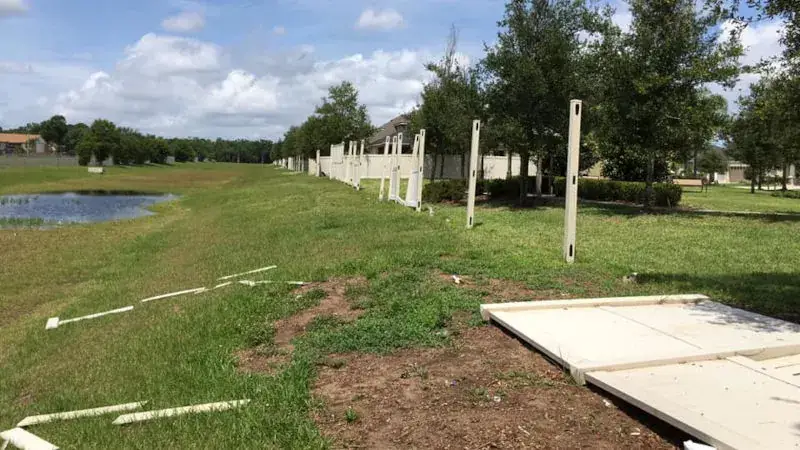
This is the most important question on the list. Fences in Central Florida usually fail at the post, not the panel: sandy soil grips a post less than clay does, and a solid 6-foot fence acts like a sail in a summer storm. Using half a bag of concrete per post saves a contractor money on every hole, and you can’t see it once the fence is up.
Our answer: 2 feet deep, with a full 50 lb bag of concrete per post. We put it in writing.
6. Exactly what materials are you quoting?
“6-foot wood fence” or “white vinyl” can describe very different products. Ask for:
- Wood: the lumber treatment, picket thickness and style (stockade, board-on-board or shadowbox).
- Vinyl and aluminum: the manufacturer and product line, and whether the warranty is in your name.
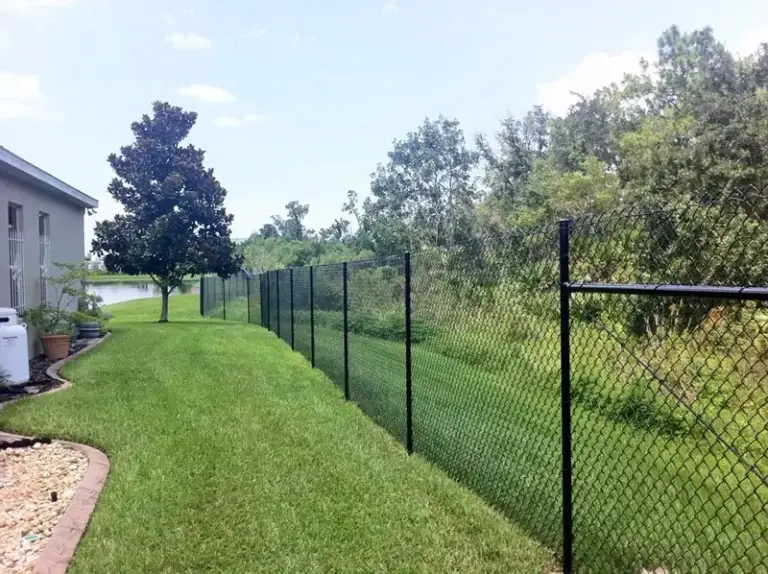
- Chain link: wire gauge, mesh size and whether it has a top rail.
- All of them: post size and post spacing.
When one bid is much cheaper than the others, the difference is almost always here: less concrete, thinner material, wider post spacing or a lighter grade.
7. How do you handle gates?
Gates are the only moving part of a fence and the first thing to sag. Ask what size posts carry the gate, what hardware is used, and which way it swings. If the fence is around a pool, the gate has to self-close and self-latch to meet Florida code, as our pool fence requirements guide explains.
Questions about price and paperwork
8. Is the quote itemized, and what isn’t included?
A good quote lists the footage, the price per foot, each gate, removal of the old fence, and the permit, each on its own line. Ask directly: “What could make this price go up?” Rock, roots, slopes and a fence line that turns out longer than measured are the usual answers. Our Orlando fence cost guide shows what each material runs per foot so you can sanity-check any bid.
Our answer: a written, itemized quote with no vague ranges, and the same price whether you pay upfront or finance.
9. Who handles the permit and the HOA?
In the City of Orlando, most residential fences 6 feet or under don’t need a permit, but taller fences, corner lots and other cities and counties are different. A contractor who says “no permit needed” should be able to tell you why for your address. Our Orlando fence permit guide covers the rules. For HOAs, ask whether they prepare the drawings and specs your board wants. Approval should be in hand before materials are ordered.
Our answer: we handle the permit when one’s needed, and our HOA fence installation team prepares the HOA paperwork.
10. Who marks the utilities and the property line?
Florida law requires a call to Sunshine 811 at least two full business days before digging, so buried lines can be marked. Ask who makes that call. Private lines such as irrigation, pool plumbing and low-voltage lighting aren’t covered by 811, so point those out yourself. Also ask how the fence line is set. If property pins can’t be found, a survey is cheaper than moving a fence.
11. What’s the payment schedule?
Ask how much is due at signing, what triggers the next payment and when the balance is due. A final payment after the walkthrough keeps everyone focused on finishing well. Under Florida’s construction lien law, a contract over $2,500 for work on your home must include a notice explaining that unpaid suppliers can file a lien on your property. Read it, and ask for a final release of lien when you make the last payment.
12. What warranty do I get, in writing?
There are two kinds. A workmanship warranty comes from the installer and covers how the fence was built. A manufacturer warranty covers the material and usually pays for replacement product, not labor. Ask how long each runs, who you call, and whether it transfers if you sell the house.
Our answer: a 5-year workmanship warranty on every fence we install, plus the manufacturer’s warranty on the material. Our fence warranties page compares each one.
How to compare quotes side by side
Put each contractor’s answers in one table. If a box is blank, ask again before you sign.
| Get this in writing | Why it matters |
|---|---|
| Total footage, height and style | Confirms every bid is for the same fence |
| Post depth and concrete per post | Decides whether the fence stays straight |
| Material brand, grade or gauge, post spacing | Explains most price gaps between bids |
| Gates: count, width, hardware | Gates are priced separately and vary a lot |
| Removal, permit and HOA paperwork | Common “extras” on a low bid |
| Payment schedule | No full payment before the work is done |
| Workmanship and material warranties | Who fixes what, and for how long |
| Start date and expected duration | Sets expectations for both sides |
The lowest number isn’t always the worst bid and the highest isn’t always the best. The best bid is the one where every line above is filled in and still makes sense.
Ask us these questions
We’d rather you ask all 12 than none. Book a free on-site estimate and we’ll walk the line with you and answer each one in writing. You can also meet the people who’ll be on your property on our about page, or get a quick number first with the instant ballpark quote.