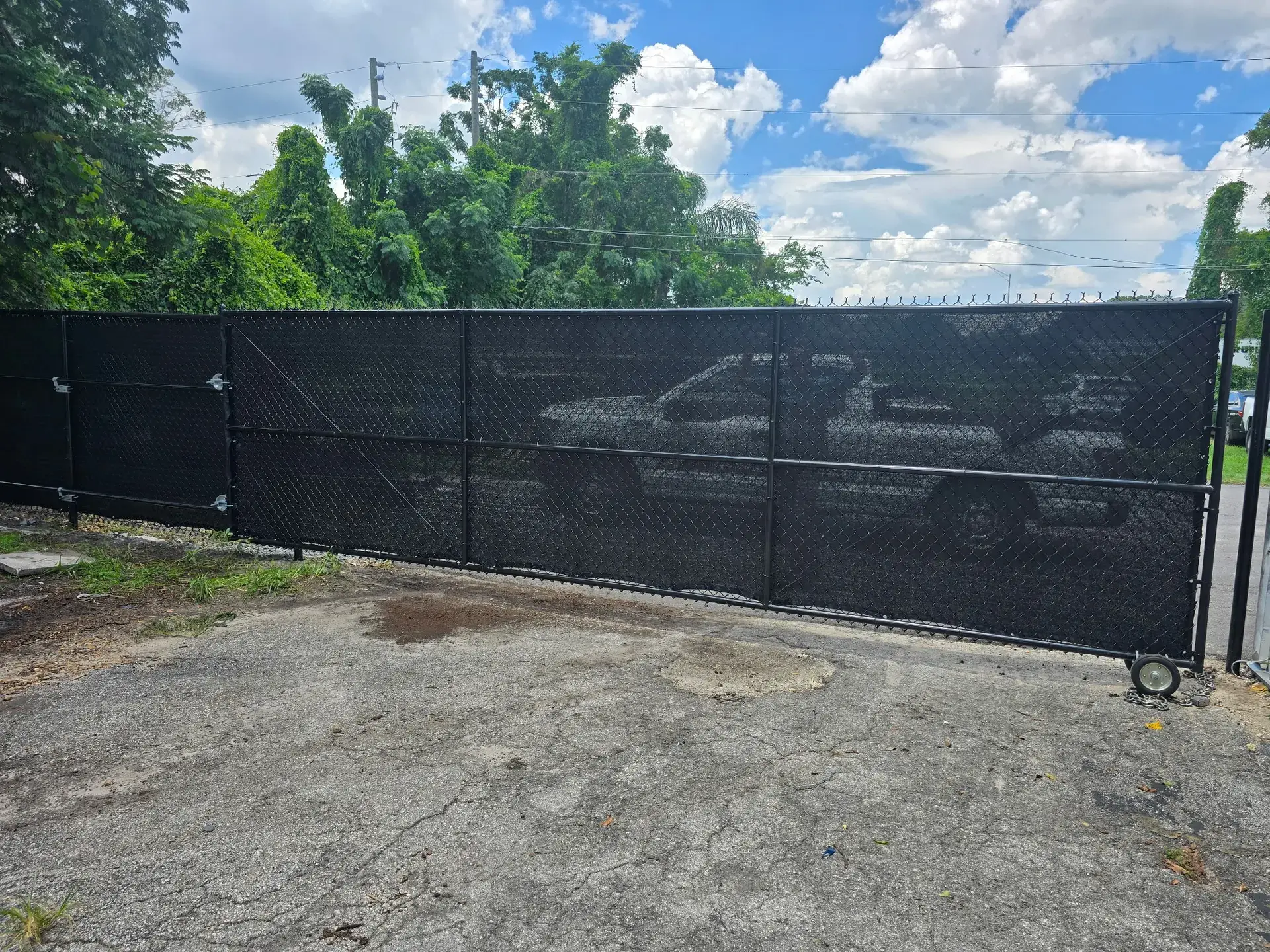
The short answer
For most Orlando businesses, a security fence is commercial-grade chain link with a tight bottom, good gates and, where zoning allows it, barbed wire on top. Spend more on other options only when the property has a problem chain link can’t solve.
Commercial chain link fits when you:
- Need to close off a yard, lot or loading area at the lowest cost per foot.
- Want cameras, lights and patrols to see through the fence.
- Store vehicles, equipment or materials outside after hours.
Choose something else (or add to it) when:
- The fence faces the street or customers and has to look good: ornamental aluminum or steel.
- Thieves are picking targets they can see: add privacy screen or slats.
- People are climbing in: add barbed wire where the code allows it, or ask about anti-climb mesh.
- Most of the risk is at the entrance: put the money into the gate.
Below we cover each option, what City of Orlando and Orange County code allows, and what our customers have actually paid. Our commercial fence installation page covers the full range we build.
Start with the problem, not the product
Security designers talk about four jobs a perimeter can do: deter (make the site look like a bad target), detect (make people easy to see), delay (slow down anyone who tries) and direct (funnel people and vehicles through controlled entrances). No fence does all four equally well, so start with why you’re calling:
- After a theft from the yard: height, a closed bottom, barbed wire where allowed and a gate that locks properly.
- Trespassers cutting through or sleeping on the property: a continuous perimeter with no gaps at buildings or tree lines, plus lighting.
- An insurer, landlord or site plan requires fencing: get the written requirement first, because it often sets the height and material.
- Customers see the fence every day: ornamental aluminum or steel that secures the site without looking like a compound.
Visibility is the trade-off to think through early. Crime-prevention guides (CPTED, crime prevention through environmental design) recommend fences that are at least partly see-through, so nobody can work unseen behind them. A solid screen hides your inventory, but it also hides whoever is inside the fence.
Option 1: Commercial chain link, the workhorse
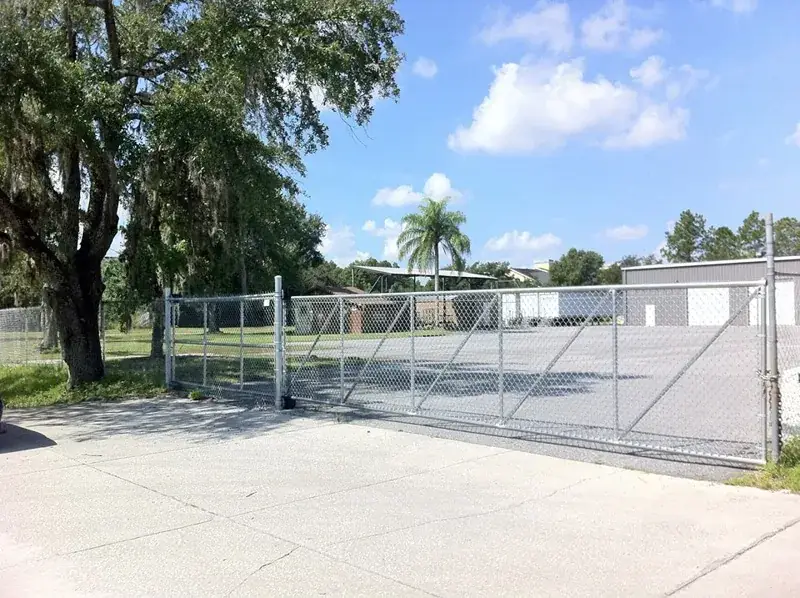
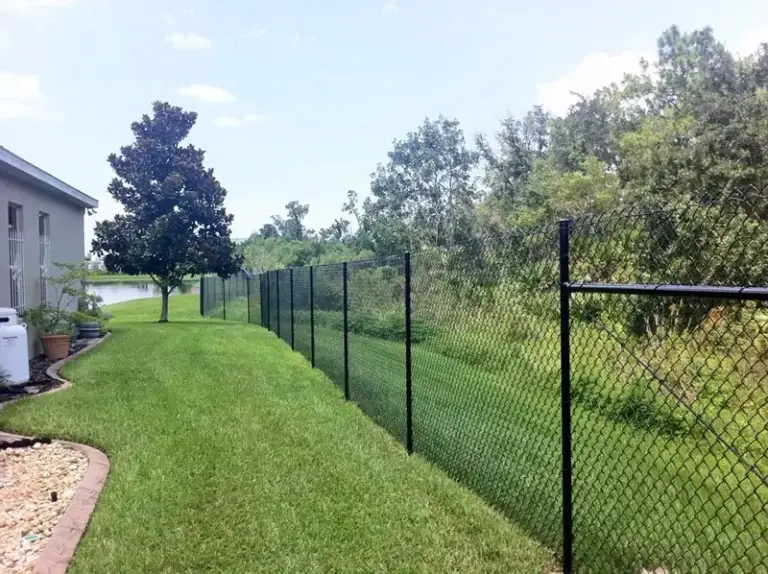
Chain link is the backbone of most commercial and industrial perimeters. It’s strong, you can see through it and it costs less per foot than anything else. Commercial chain link isn’t the same product as the fence in a back yard, though. The differences that matter for security:
- Heavier wire. Federal security guidance calls for 9-gauge wire or heavier with mesh openings no larger than 2 inches. That’s the standard commercial fabric, and it takes real time to cut.
- Heavier posts and framework. Terminal and corner posts take the tension of the whole run, so commercial systems use larger, thicker pipe.
- A closed bottom. The fabric should sit within 2 inches of hard ground and stay there. A bottom tension wire or bottom rail stops people from lifting the mesh and crawling under, which is the most common way in.
- Galvanized or black. Galvanized costs less. Black vinyl-coated looks better next to a building or a street.
Height matters as much as wire. In the City of Orlando, commercial and industrial fences can go up to 6 feet in required front and street-side yards and 8 feet in side and rear yards. Our industrial fence installation page covers long runs, wide truck gates and the grade changes that come with big sites.
Option 2: Barbed wire, if your zoning allows it

Three strands of barbed wire on top of chain link is cheap and one of the strongest climbing deterrents you can add. Where it’s allowed depends on where the property is, and the rules differ more than most owners expect:
- City of Orlando: the code treats barbed wire and electric fences as “security fences.” They’re prohibited except where Section 58.930 allows them, mainly in industrial zoning districts and certain airport-support uses. Plain chain link isn’t a security fence under this code. It becomes one when barbed wire or another defensive feature is added. Razor wire and broken glass are banned citywide except at jails and prisons.
- Unincorporated Orange County: barbed wire or razor wire may top fences in commercial and industrial districts. The limits are no more than 3 strands, no more than 18 inches tall, starting at least 6 feet above the ground, with a total height of 10 feet or less. It’s prohibited in residential and office districts, and it can never project over a sidewalk, a street or a neighbor’s property.
- Other cities (Winter Park, Ocoee, Kissimmee, Sanford and the rest) have their own rules. Check before you plan on it.
We confirm the zoning before barbed wire goes on a quote. It costs far less to find out at the estimate than when an inspector or a code-enforcement letter tells you.
Option 3: Privacy screen and slats
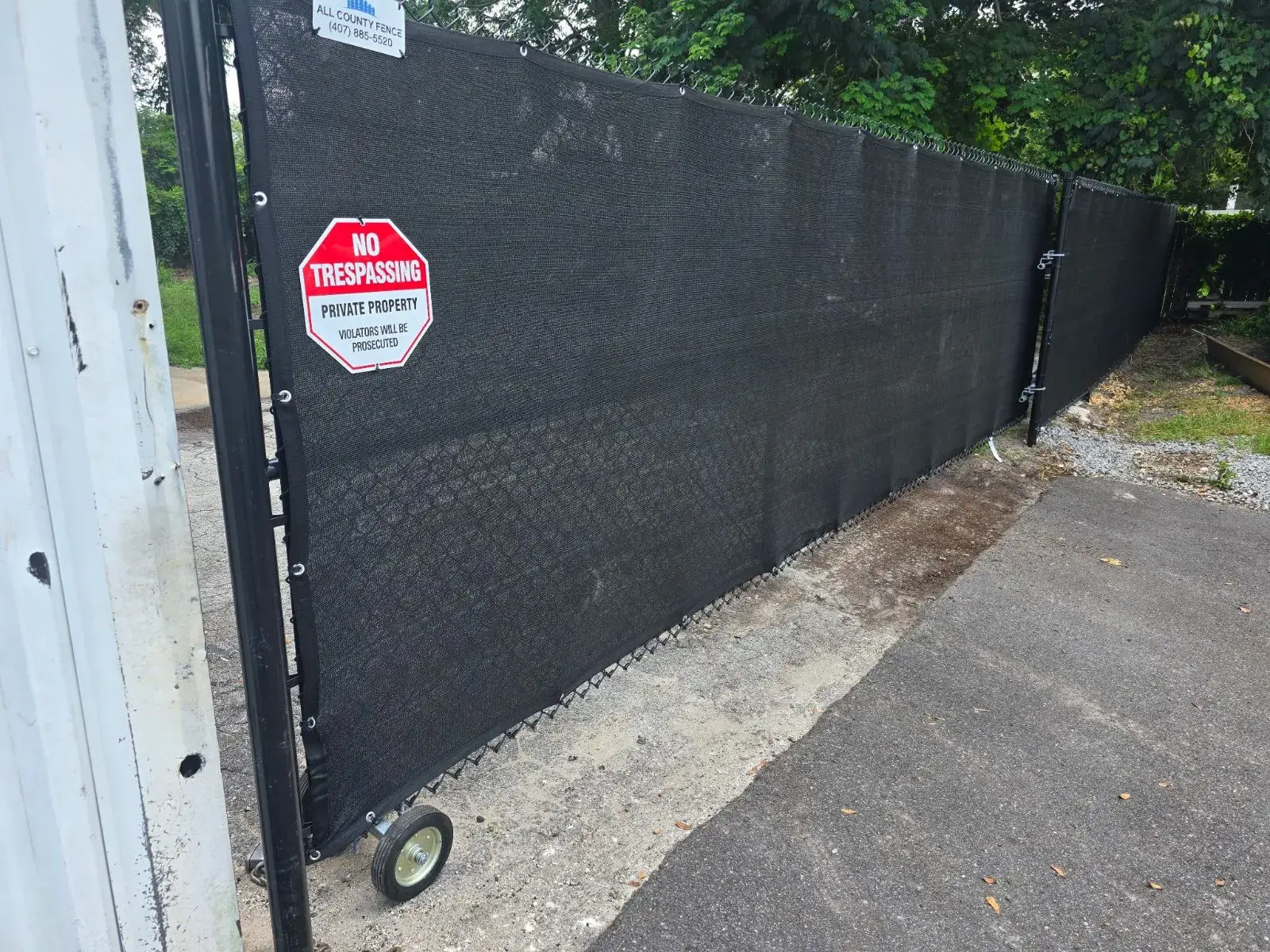
A lot of yard theft is opportunistic: someone sees the copper, the trailers or the tools from the road and comes back at night. Screening takes the shopping list away. You have two choices:
- Privacy screen: hemmed, grommeted fabric tied to the fence. In our 2026 estimates, black 85% screen ran about $4.35 to $6.72 per foot. It’s the fastest way to hide a whole lot.
- Privacy slats: strips woven into the mesh. They look neater and last longer, at about $15.47 per foot in our estimates. Our guide to chain link privacy slats covers how much privacy each style actually gives.
Two cautions. First, the visibility trade-off from above: screening hides your property from thieves, but it also hides anyone inside the fence from patrols. Many owners screen the street side and leave the back open. Second, wind. A screened fence catches far more wind than open mesh, so tell us about screening when you get a quote, not after. The posts and footings have to be planned for it.
Option 4: Ornamental aluminum and steel for the frontage
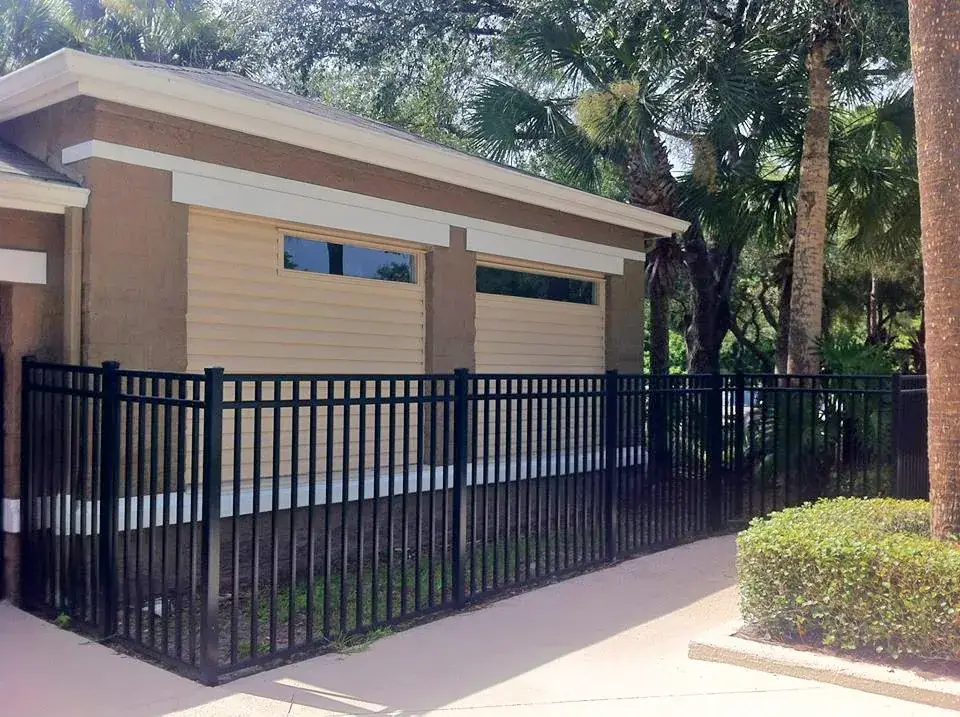
Offices, medical buildings, apartment communities and retail frontage usually need security that doesn’t look like security. That’s what ornamental fence is for: vertical pickets with no footholds between the rails, powder-coated so it won’t rust, and see-through so it works with cameras.
- Commercial-grade aluminum uses heavier pickets, rails and posts than residential styles. Spear tops make climbing uncomfortable. Flat-top styles look cleaner where appearance comes first.
- Ornamental steel is stronger again, for sites that want the look and more resistance to impact and cutting.
- Anti-climb panels: on one recent job we welded expanded metal to the lower 24 inches of a 6 ft commercial aluminum fence so nobody could get a grip.
Orlando gives this style a height bonus. City code lets commercial and industrial fences go 2 feet over the normal height limit when the fence is an approved CPTED fence: a wrought iron or wrought-iron-type fence, with no barbed wire. In practice, a decorative metal fence can reach 8 feet in a front yard and 10 feet in side and rear yards where a chain link fence would stop at 6 and 8.
Option 5: High-security mesh
Utilities, data centers, substations and some distribution sites need more delay than standard chain link gives. The industry options include:
- Mini-mesh chain link with ½-inch or ⅜-inch openings, too small for fingers or toes and slow to cut.
- Heavier 6-gauge chain link, for sites where copper and equipment theft is the main risk.
- Welded “358” anti-climb mesh (3 by ½-inch openings) on rigid panels, tested to the ASTM F2781 forced-entry standard.
These systems cost considerably more than commercial chain link, and most Orlando businesses don’t need them. If a corporate security standard or an insurer calls for one, send us the written spec with your estimate request so we can price exactly what it requires.
Gates: where most security fences fail
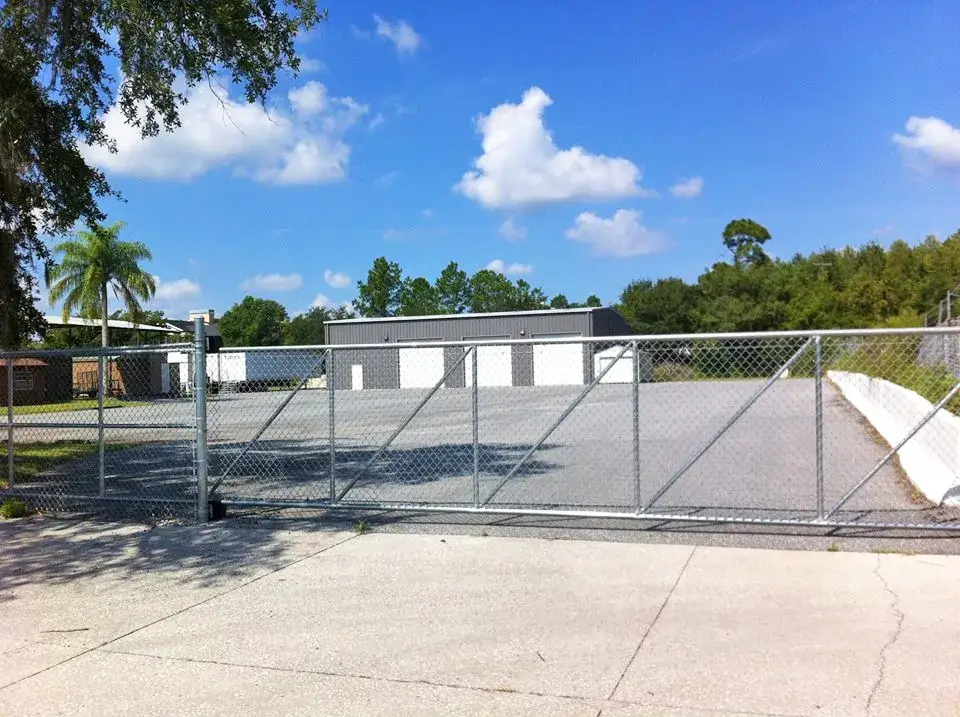
A perimeter is only as good as its entrance. A gate left open for deliveries, a sagging gate that won’t latch or a gap beside the gate post undoes everything else. The three types:
- Swing gates (single or double): the simplest and least expensive. They need clear room to swing, which rules them out on many tight lots.
- Rolling gates: slide along the fence line on wheels. They’re good for wide openings without room to swing, but they need fairly level, solid ground to roll on.
- Cantilever gates: slide on rollers mounted to heavy posts, with no wheels touching the ground. They cost the most and work best on long spans and rough ground.
Size the opening around the largest vehicle that uses it and its turning radius, not the width of the driveway apron. For gates on a fire department access road, the City of Orlando’s fire plan review checks for 20 feet of clear width and 13 feet 6 inches of clear height. Where Orange County Fire Rescue is the fire authority, it requires automated gates on secured properties to have Click2Enter with a Knox key switch override, permitted through the Office of the Fire Marshal. Pedestrian gates may also need panic hardware so people can get out in an emergency.
We build gates automation-ready and coordinate the operator, keypad or card reader with a licensed access-control specialist. Our security gate installation page has more on swing, rolling and truck-width gates.
Inside the building: cages and enclosures
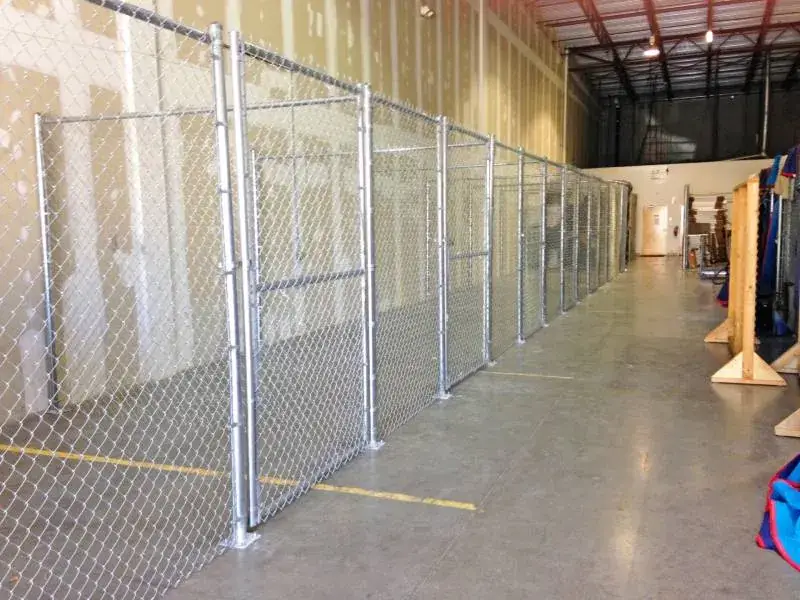
A lot of loss happens inside the fence line. Chain link cages and partitions lock up tool cribs, inventory, server racks and parts rooms, mounted to the floor and walls with lockable doors. Outside, enclosures around generators, AC units and backflow preventers stop copper theft. Our security fencing and metal cage installation page covers both. If your problem is the back of house rather than theft, a dumpster enclosure tidies the service area and keeps out people who don’t belong there.
Permits and code in Orlando
- A permit is required for any fence on a commercial property inside the City of Orlando, including apartment properties with three or more units. Vehicular and powered gates also need a permit, and fences on or near public easements get extra review.
- Height: 6 feet in required front and street-side yards and 8 feet in side and rear yards for commercial and industrial sites, plus 2 feet for an approved CPTED-style metal fence. Pillars and posts can rise 12 inches above the limit if they’re at least 10 feet apart.
- Site plans and overlays: an approved site plan, a planned development or an overlay district can set its own height, material and placement rules. We work from your plan.
- Outside city limits, unincorporated Orange County, Seminole County and each city have their own rules. Many “Orlando” addresses aren’t in the city at all.
We pull the permit and coordinate the inspections. On our recent commercial estimates, the permit line has run about $725 to $1,500, depending on the job and the jurisdiction. The residential side of these rules is in our Orlando fence permit guide.
What commercial security fencing costs
These are installed prices (materials, labor, posts in concrete and cleanup) from our own commercial estimates, June to November 2026, before any project discount. Per-foot prices drop as runs get longer, and short runs can cost close to twice as much per foot.
| Item | Our installed price |
|---|---|
| 6 ft commercial galvanized chain link, 250 to 500 ft runs | About $21 to $26 per foot |
| 6 ft commercial galvanized chain link, 50 to 150 ft runs | About $28 to $41 per foot |
| 6 ft commercial black chain link, 150 ft and up | About $22 to $32 per foot |
| 8 ft commercial chain link, 100 to 150 ft run | About $36 (galvanized) to $44 (black) per foot* |
| 3-strand barbed wire, added on top | About $1.40 to $2.50 per foot |
| Bottom tension wire | About $0.75 to $1.50 per foot |
| Privacy screen / privacy slats | About $4.35 to $6.72 / $15.47 per foot |
| Commercial-grade aluminum, 4 to 6 ft | About $61 to $63 per foot |
| Commercial chain link walk gate (up to 5 ft wide) | About $1,000 (galvanized) to $1,400 (black) |
| Commercial chain link double swing gate (8 to 16 ft) | About $1,570 to $2,700 |
| Commercial chain link rolling gate (12 to 24 ft) | About $2,000 to $3,330 |
| Cantilever gate (20 to 24 ft) | About $4,700 to $6,100 |
*From one recent estimate each.
A real example: one recent quote covered about 440 feet of 6 ft commercial galvanized chain link with three strands of barbed wire, a bottom tension wire, corner bracing and two 16 ft rolling gates topped with barbed wire, plus removal of the old fence. It came to about $15,800.
What moves the price:
- Concrete and asphalt. Posts set through pavement need core drilling, priced per hole.
- Number of gates. On short perimeters, gates can cost more than the fence.
- Removal of an old fence (about $2.60 to $5.20 per foot in our estimates).
- Grade changes, tree lines and buildings the fence has to tie into.
- Working around operations: phasing the job so trucks and customers can keep using the site.
Residential prices are in our Orlando fence cost guide. Commercial work is quoted from a site walk.
Before you get quotes: a checklist
- Write down the problem: theft, trespass, liability, insurer or a site-plan requirement.
- Find your zoning and whether you’re in city limits. That decides height and whether barbed wire is allowed.
- Get any written requirement from your insurer, landlord, HOA or corporate security team.
- Count your entrances and note the largest vehicle that uses each one.
- Decide on automation now, even if you’ll add it later, so gate posts and frames are sized for an operator.
- Ask every contractor for the same specs in writing: fence height, wire gauge, post sizes, bottom treatment, gate type and hardware, and who pulls the permit.