The short answer
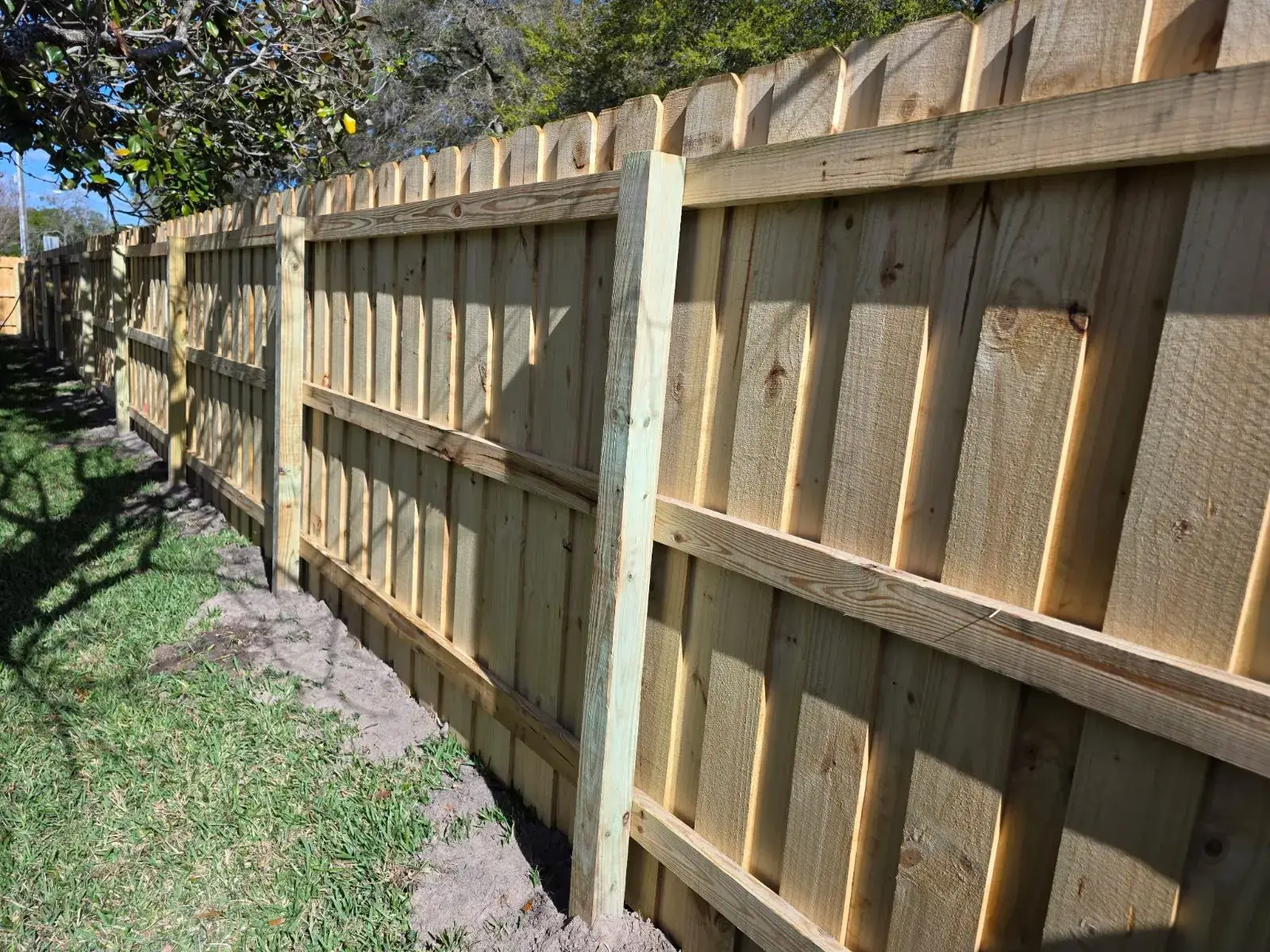
Board-on-board is the more private of the two: its boards overlap, so you can’t see through it from any angle, even after the wood shrinks. A shadowbox fence alternates boards on both sides of the rails. It looks the same from both yards and lets some breeze through, but you can see through it at an angle. In our estimates the two cost the same per foot.
Board-on-board fits when you:
- Want full privacy for a pool, patio or bedroom windows.
- Don’t want see-through gaps when treated pine shrinks over its first months.
- Are fine with the rails and posts showing on your side.
Shadowbox fits when you:
- Share the fence with a neighbor and want it to look finished from both yards.
- Want air to move through a hot, still backyard.
- Have an open lot where storm wind hits the fence hard.
- Are fine with glimpses through the fence from an angle.
Below we explain how each one is built, how they handle Florida wind and shrinking lumber, and what our customers have actually paid. Our wood fence installation page covers every wood style we build.
How each fence is built
Both styles start the same way: posts set in concrete, two or three horizontal rails between them, and vertical pickets (usually 5½ inches wide) fastened to the rails. What’s different is where the pickets go.
Board-on-board: two overlapping layers
The crew fastens a first row of pickets with gaps a little narrower than a board. Then a second row goes on top, centered over the gaps, so every board overlaps its neighbors by about an inch on each edge. The result is a solid wall of wood with a slight shadow line between boards, which looks more finished than a flat stockade fence.
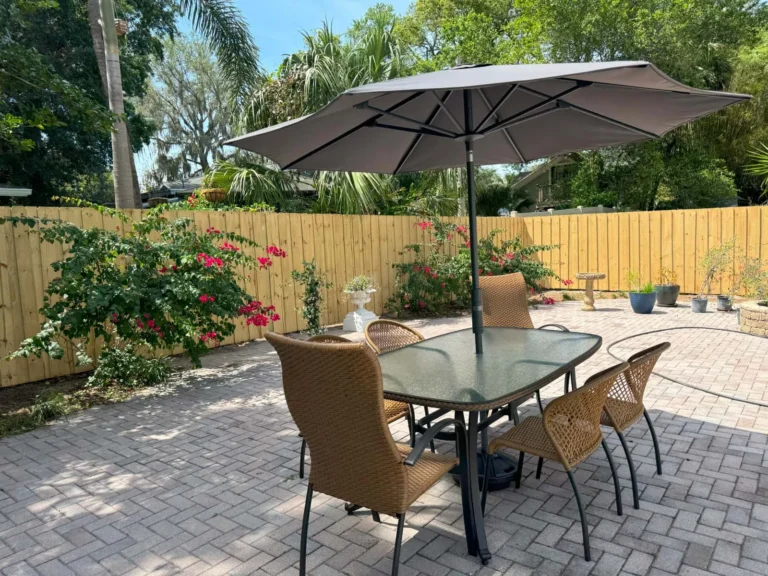
The fence in this post’s cover photo is built that way, with both layers on the same side of the rails. The smooth, layered side faces out and the posts and rails face your yard.
Shadowbox: boards on alternating sides
Shadowbox puts every other board on the opposite side of the rails. Each board on your side covers the gap between two boards on your neighbor’s side, with a small overlap on each edge, and the rail sits in the middle. Head-on, you can’t see through it. Walk along it and look at an angle and you catch glimpses of the other side, and air moves through the offset.
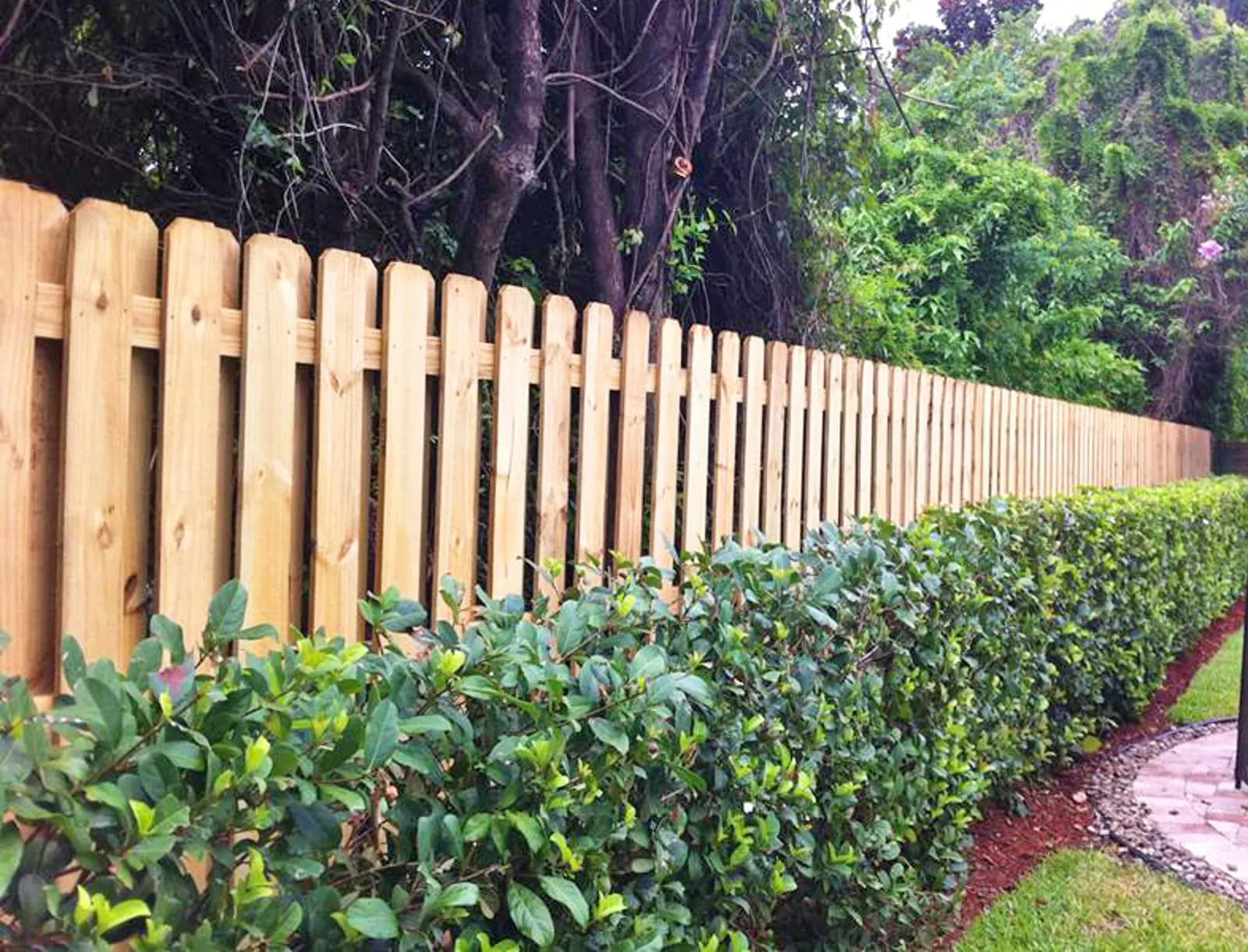
A note on names: contractors use these terms loosely. Some call an alternating fence with overlapped boards “board-on-board,” and some call any two-sided fence a “good neighbor” fence. Before you sign, ask how the pickets will go on: both layers on one side, or alternating sides, and how much overlap. A good estimate spells it out.
Board-on-board vs. shadowbox, side by side
| Board-on-board | Shadowbox | |
|---|---|---|
| Privacy | Solid from every angle | Solid head-on, glimpses at an angle |
| Gaps as the wood shrinks | None: the overlap covers them | The angled view opens a little more |
| Airflow and wind | Blocks the wind, so posts take the full load | Some air passes, so less load on posts |
| Looks from each side | Finished face out, rails on your side* | The same from both yards |
| Lumber | About 20 to 30% more pickets than stockade | About the same as board-on-board |
| Our price, 6 ft, 150–250 ft run | About $26 per foot | About $26 per foot |
*When both layers go on one side of the rails, as in our cover photo.
Privacy: what you’ll actually see
If the whole point of the fence is not being seen (a pool, a hot tub, a patio that faces a two-story neighbor), choose board-on-board. Every board overlaps the next, so there’s no line of sight at any angle.
A shadowbox fence blocks the view when someone looks straight at it, which is how most people see a fence. The gaps show up when you look along it: from a sidewalk running beside the fence, or from the neighbor’s yard at the corner. For a back property line where nobody walks alongside it, most people never notice. For a side yard next to a neighbor’s driveway, they might.
Both are full privacy fences compared with the alternatives. If you’re still choosing between materials, our privacy fence ideas for Central Florida compares wood with vinyl, horizontal boards and screened chain link.
Florida wind: why shadowbox has an edge
A solid 6-foot fence acts like a sail. In a summer thunderstorm or a tropical storm, the wind pushes on every square foot of boards, and the posts lever that force into the ground. Wood fences here usually fail at the posts, not the boards.
Shadowbox lets some of that air through the offset boards, so the same gust pushes less on each post. That makes it the better pick for open lots, corner lots and fences that face a retention pond or a field, where wind has room to build up.
Board-on-board can handle Florida wind too. It just depends more on the posts: we set ours 2 feet deep with a full 50 lb bag of concrete, because Central Florida’s sandy soil grips a post less than clay does. Whichever style you choose, ask any contractor how deep the posts go and how much concrete each one gets.
Shrinking lumber and why the overlap matters
Pressure-treated pine arrives wet from the treatment plant. Over its first months in the Florida sun it dries out and shrinks across its width; the USDA Wood Handbook puts southern pine’s shrinkage from green to fully dry at about 7 to 8% across the grain. On a 5½-inch picket, the drying that happens outdoors can easily take off an eighth to a quarter of an inch.
- On a stockade fence, where boards are butted tight, that shrinkage opens thin see-through gaps between every board.
- On a board-on-board fence, the inch of overlap covers it. The fence stays solid.
- On a shadowbox fence, the overlap on each edge shrinks a little, so the angled glimpses get slightly wider. Head-on, it still blocks the view.
This is the main reason we’d point a privacy-first customer to board-on-board rather than stockade, even though stockade costs less.
What each one costs in Orlando
We price board-on-board and shadowbox the same, because they use about the same lumber and labor. These are installed prices (materials and labor) from our estimates written in 2026, for 6-foot pressure-treated pine:
| 6 ft wood fence, installed | Per foot | 150-foot backyard |
|---|---|---|
| Stockade (for comparison) | About $24 | About $3,600 |
| Board-on-board or shadowbox | About $26 | About $3,950 |
| Board-on-board with cap and face board | About $37 | About $5,550 |
| 8 ft board-on-board | About $36 to $42 | About $5,450 to $6,350 |
Gates are separate: about $275 for a 6-foot wood walk gate (up to 5 feet wide) and $575 for a double drive gate (up to 10 feet wide). A few things change the number:
- Length. The 150-to-250-foot price above is about $26 per foot. On a 50-to-100-foot run it was about $36 per foot, and on a 25-to-50-foot run about $53, because setup costs don’t shrink with the fence.
- Cap and face board. A flat cap on top with a trim board under it added about $10.75 per foot. It sheds water off the picket tops and gives the fence a framed look.
- Cedar pickets. Upgrading 6-foot pickets from pine to cedar usually added about $4 per foot.
- Removal of an old fence, permits, and tough access are quoted per job.
Every material we install is priced side by side in our Orlando fence cost guide.
Neighbors, HOAs and code
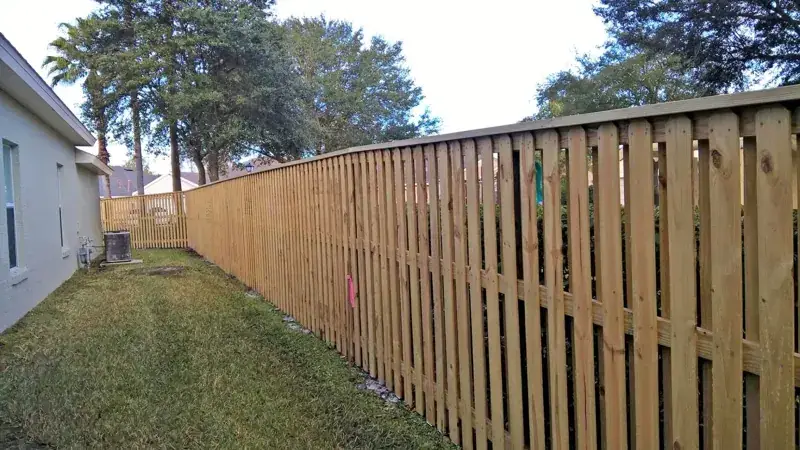
- Finished side out. The City of Orlando asks for the finished side of a wood fence to face outward, with posts and rails toward your property. A shadowbox fence settles the question because both sides look the same. With a one-sided board-on-board fence, the smooth face goes to the neighbor.
- Height. In the City of Orlando, a residential fence can be 6 feet in side and rear yards and 4 feet in a front yard without a permit when the other exemption conditions are met. Anything over 6 feet needs a permit. Our Orlando fence permit guide covers the details and how other cities differ.
- HOA rules. Many HOAs name the fence style, height and finish, and some require a design that looks the same from both sides. Get the approval in writing before materials are ordered. Our HOA fence installation team handles the paperwork and matches community specs.
- Talk to your neighbor. If the fence is on a shared line, showing them the style first avoids most disputes. Shadowbox is the easy “yes.”
Dogs, staining and upkeep
- Dogs: both styles have no gaps big enough for a dog to squeeze through. A dog that reacts to what it sees may do better behind board-on-board, which hides everything. More on that in our guide to the best fence for dogs in Central Florida.
- Staining: board-on-board has overlapping edges that are hard to reach once the fence is up, and shadowbox has two exposed faces plus every board edge. Either way, staining takes more time and product than on a stockade fence. Treated pine should dry out for a few months before you stain it.
- Repairs: a broken picket is a quick swap on either style.
Which one should you choose?
- Privacy is the whole point (pool, patio, two-story neighbor): board-on-board.
- The fence is on a shared line and you want both yards happy: shadowbox.
- Open, windy lot or a long run facing a pond or field: shadowbox, or board-on-board with posts set deep.
- Tightest budget and you can live with thin gaps later: stockade, about $2 per foot less.
- The HOA decides: check the guidelines first, then pick.
Still deciding? See finished jobs in our wood fence gallery, or ask us to show you both styles on your property line during a free estimate. If privacy is the main goal, our privacy fence installation page shows every option we build.