The short answer
A fence that serves as a pool barrier in Florida has to meet Florida Statute 515.29 and the pool barrier section of the Florida Building Code (R4501.17). In plain English, the fence must be:
- At least 48 inches tall, measured on the outside (the side away from the pool).
- Tight enough that a 4-inch ball can’t pass through any opening, with no more than 2 inches between the ground and the bottom of the fence.
- Hard to climb: rails closer than 45 inches apart go on the pool side, and nothing permanent next to the fence can be used as a step.
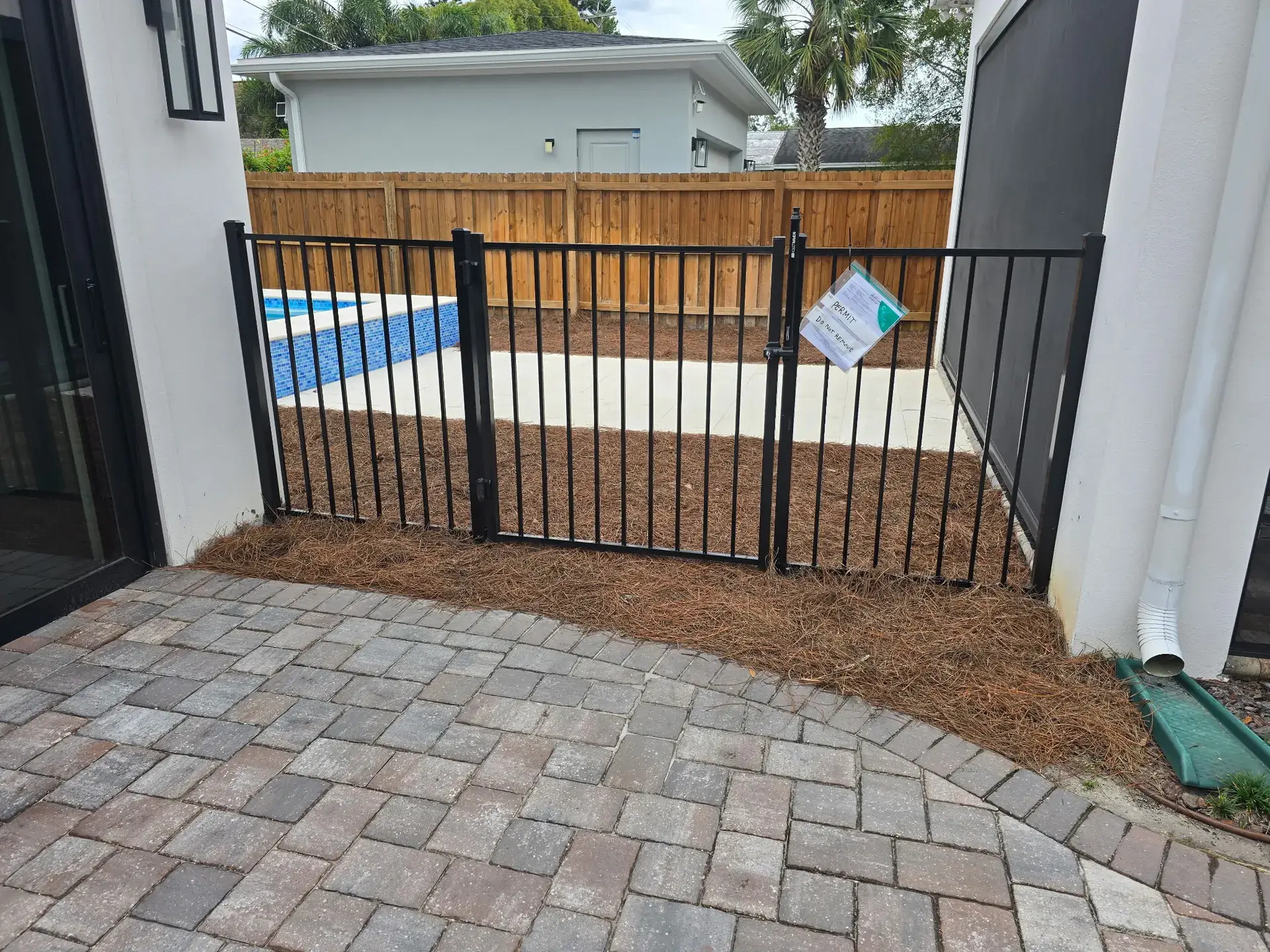
- Gated the right way: every gate opens outward, away from the pool, closes on its own and latches on its own. The latch release sits at least 54 inches up or on the pool side where a child can’t reach it.
- Around the pool, not just the yard, unless the yard fence sits on the pool’s perimeter and meets every one of these rules.
On top of the state rules, your city or county decides whether you need a permit. Inside Orlando, any fence used as a pool barrier needs one. Below, we go through each rule, the details that fail inspections, and what a code-compliant pool fence in Orlando costs with us.
Which law applies to your pool
Florida’s Residential Swimming Pool Safety Act (Chapter 515) is the state law. It says a new residential pool can’t pass final inspection unless it has at least one of five safety features (Fla. Stat. 515.27):
- A barrier that isolates the pool from the house and meets 515.29 (a fence, a screen enclosure, a wall, or a mix).
- An approved safety pool cover (ASTM F1346).
- Exit alarms on every door and window that opens straight to the pool, at least 85 decibels at 10 feet.
- Self-closing, self-latching doors to the pool, with the release at least 54 inches above the floor.
- A pool alarm in the water, certified to ASTM F2208.
Skip all five on a new pool and it’s a second-degree misdemeanor. The Florida Department of Health still recommends more than one layer, and many Central Florida pools end up with two: a fence or screen enclosure, plus alarms or self-closing hardware on the house doors.
The Florida Building Code turns the state law into measurements: ball sizes, rail spacing, latch heights. That’s what your building inspector checks. Cities and counties then add their own permit rules and height limits on top.
Older pools: the Act covers pools built after it took effect in 2000. The health department estimates more than 90% of Florida’s home pools are older than that. If you’re replacing the fence around an older pool and that fence acts as the pool barrier, plan on building the new one to today’s rules. In Orlando, it will need a permit either way.
Height: 48 inches, measured from the outside
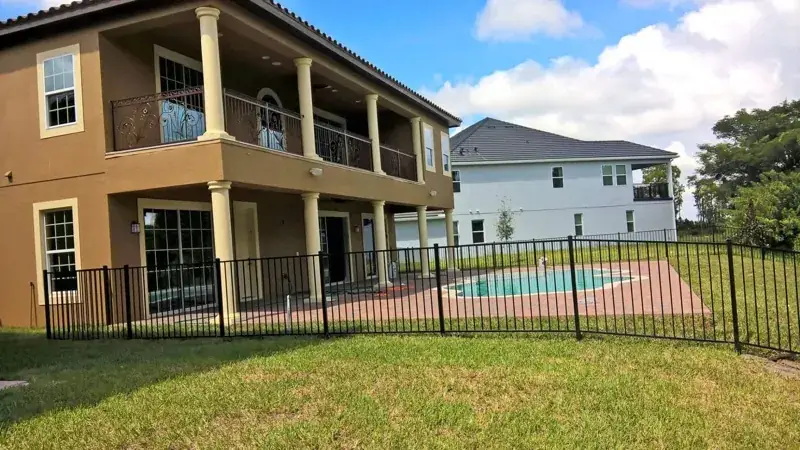
The barrier has to be at least 4 feet tall on the outside, the side a child would climb from. Two things catch people out:
- Slopes and low spots. The 48 inches applies along the whole run. Where the yard dips, a fence that’s 48 inches at the post can come up short in the middle of a panel.
- Raised beds and mulch. Piling soil or mulch against the outside of the fence raises the grade and shrinks the height. Keep the outside grade where it was at inspection.
Taller is allowed, up to your city’s limit. Inside Orlando that’s 6 feet for most homes, and the city’s pool checklist sets 4 feet as the minimum. Many people go to 5 feet with aluminum, which costs only a little more per foot than 4 feet (prices below).
Gaps: the 4-inch ball test
No opening in the barrier can let a 4-inch sphere through. That’s roughly the size of a toddler’s head, and it applies everywhere: between pickets, under gates, between a gate and its post, and where the fence meets the house or the screen enclosure.
At the bottom, the Building Code allows no more than 2 inches between the ground and the fence on the outside. Central Florida sand washes out, so a fence that cleared inspection can fail later where rain has dug a channel under a panel. Walk the line after a summer of storms and fill any low spots.
The code adds more specific limits by fence type:
| Fence type | Code limit (FBC R4501.17) | What it means in practice |
|---|---|---|
| Picket fence with rails 45 inches or more apart | Pickets no more than 4 inches apart | Standard pool-style aluminum: pickets about 3¾ inches apart |
| Picket fence with rails less than 45 inches apart | Rails on the pool side and pickets no more than 1¾ inches apart | Rails close together work like ladder rungs, so the code makes them hard to use |
| Chain link | Mesh no larger than 2¼ inches, or 1¾ inches with slats | Standard 2-inch residential mesh passes |
| Lattice or diagonal pieces | Openings no more than 1¾ inches | Decorative lattice tops on the outside are a common fail |
| Solid wood or vinyl | No footholds or protrusions on the outside | Rails and posts face the pool, smooth side out |
That 45-inch rail rule is why pool-style aluminum panels look the way they do: either two rails, one at the top and one at the bottom, or a third rail tucked up near the top, so there’s a tall span with nothing to step on. Extra rails added for looks or for a small dog can change the math, so pick the panel with the pool in mind. (If the fence also has to hold in a dog, our guide to the best fence for dogs covers picket spacing and dig-outs.)
Gates: where most pool fences fail
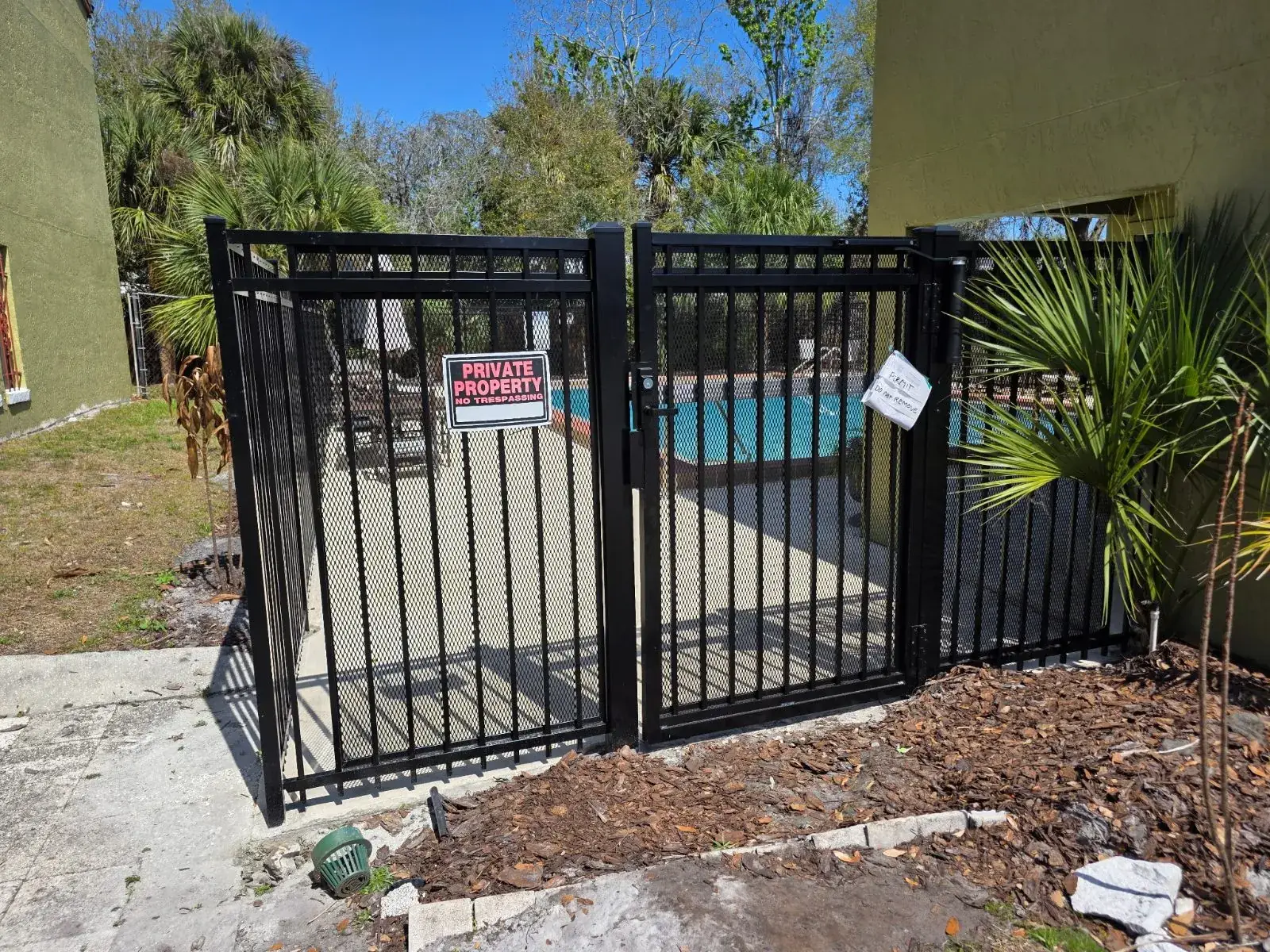
The panels rarely fail an inspection. The gate does. A pool gate must:
- Open outward, away from the pool. A child pushing on it from the yard side pushes it shut.
- Close by itself from any open position, including when it’s only open a few inches.
- Latch by itself when it closes, without anyone lifting or pushing the latch.
- Keep the release out of reach: at least 54 inches above the bottom of the gate, or on the pool side and placed so a child can’t reach it over the top or through a gap. Within 18 inches of the release, the gate and fence can’t have any opening wider than half an inch.
Most pool gates use spring hinges and a magnetic pool latch mounted high on the post. Those parts work hard in Florida heat and wind. Over time the hinge loses tension, the gate sags or the post shifts, and the latch stops catching. Test it every month: open the gate a little, let go, and watch it close and latch on its own. Then repeat from halfway and from fully open.
A pool gate that won’t latch is a gate that isn’t doing its job. If we built your fence, our fence and gate repair team can adjust or replace the hardware.
The house wall, the screen enclosure and the yard fence
When the house is part of the barrier
The wall of your home can be one side of the barrier only if it has no door or window that opens straight to the pool. Most homes do have one, so the code requires one of these on those openings:
- Exit alarms on each door and window that opens to the pool (85 decibels at 10 feet), with any shut-off switch at least 54 inches up.
- Self-closing, self-latching hardware on each door, with the release at least 54 inches above the threshold.
- A pool alarm in the water that meets ASTM F2208.
That’s why a 3-sided fence that ties into the back of the house is common, but it isn’t finished until the doors are handled.
Screen enclosures
A standard pool cage can serve as part or all of the barrier, as long as it meets the same rules: 48 inches of height, no openings a 4-inch ball can pass, and a screen door that opens outward and self-closes and self-latches. Many cage doors don’t, and a torn bottom screen panel is an opening. Once the cage is the barrier, the house doors that open into the cage need the alarms or hardware above.
The yard fence
Your backyard fence counts as the pool barrier only if it sits on the pool’s perimeter and meets every rule on this page, gates included. A 6-foot privacy fence around the whole yard can do it, but every gate in it then becomes a pool gate: outward-swinging, self-closing and self-latching. That includes the wide gate you use for the mower. If that’s not practical, give the pool its own barrier inside the yard.
How far the barrier sits from the water
Florida law says the barrier must be far enough from the water’s edge that a child who gets through it can’t fall straight in. For removable mesh barriers (often called baby fences), the Building Code puts that at at least 20 inches from the water. Walls and screen enclosures can sit as close as the rest of the code allows.
Two more placement rules matter on most jobs:
- No climbing aids. The fence can’t be placed where a permanent structure or equipment lets a child climb over it. Pool pumps, AC units, planters, retaining walls and benches are the usual problems. Lay out the fence line around them.
- Metal fences near the water. If a metal fence, aluminum included, is within 5 feet of the pool’s inside walls, the electrical code may require it to be bonded to the pool’s bonding grid. Seminole County’s fence permit checklist asks about exactly this. Setting the fence line back avoids the question, or your pool electrician can bond it.
Permits in Orlando and nearby counties
A pool barrier is one of the exceptions to Orlando’s “no permit for a 6-foot backyard fence” rule, and the one homeowners run into most. Here’s what we see across the area:
- City of Orlando: a fence used as a pool or spa barrier needs a building permit. The city requires a permitted fence for any pool 2 feet or deeper and 36 square feet or larger, inflatable pools included. Fences must be 4 to 6 feet tall for most homes.
- Lakefront lots in Orlando: the city’s pool checklist lets a see-through, vinyl-coated chain link fence up to 48 inches tall extend into the lake up to 2 feet past the low-water mark, so the barrier can close off at the water. A lake on its own counts as a barrier only if the building official approves it.
- Unincorporated Orange County: a new pool permit needs a site-specific Swimming Pool Safety Affirmation saying which barrier you’ll use, and the county keeps a list of approved barrier products.
- Seminole County and other cities: fence permit forms ask whether the fence is the pool barrier, so plan for it to be reviewed and inspected as one.
When the permit is ours to pull, it’s on the quote: about $110 in unincorporated Orange County and Ocoee, and $165 to $220 in other cities, in our recent estimates. Our Orlando fence permit guide covers the rest of the city’s fence rules.
Which fence materials pass
- Aluminum: the most common pool fence around Orlando. Pool-style panels meet the spacing rules out of the box, it doesn’t rust, and you keep the view of the water. See aluminum fence installation for styles and colors.
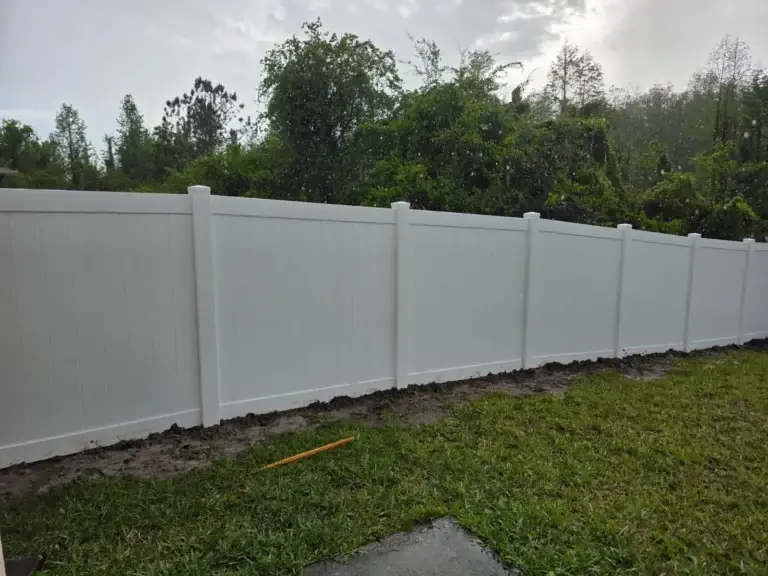
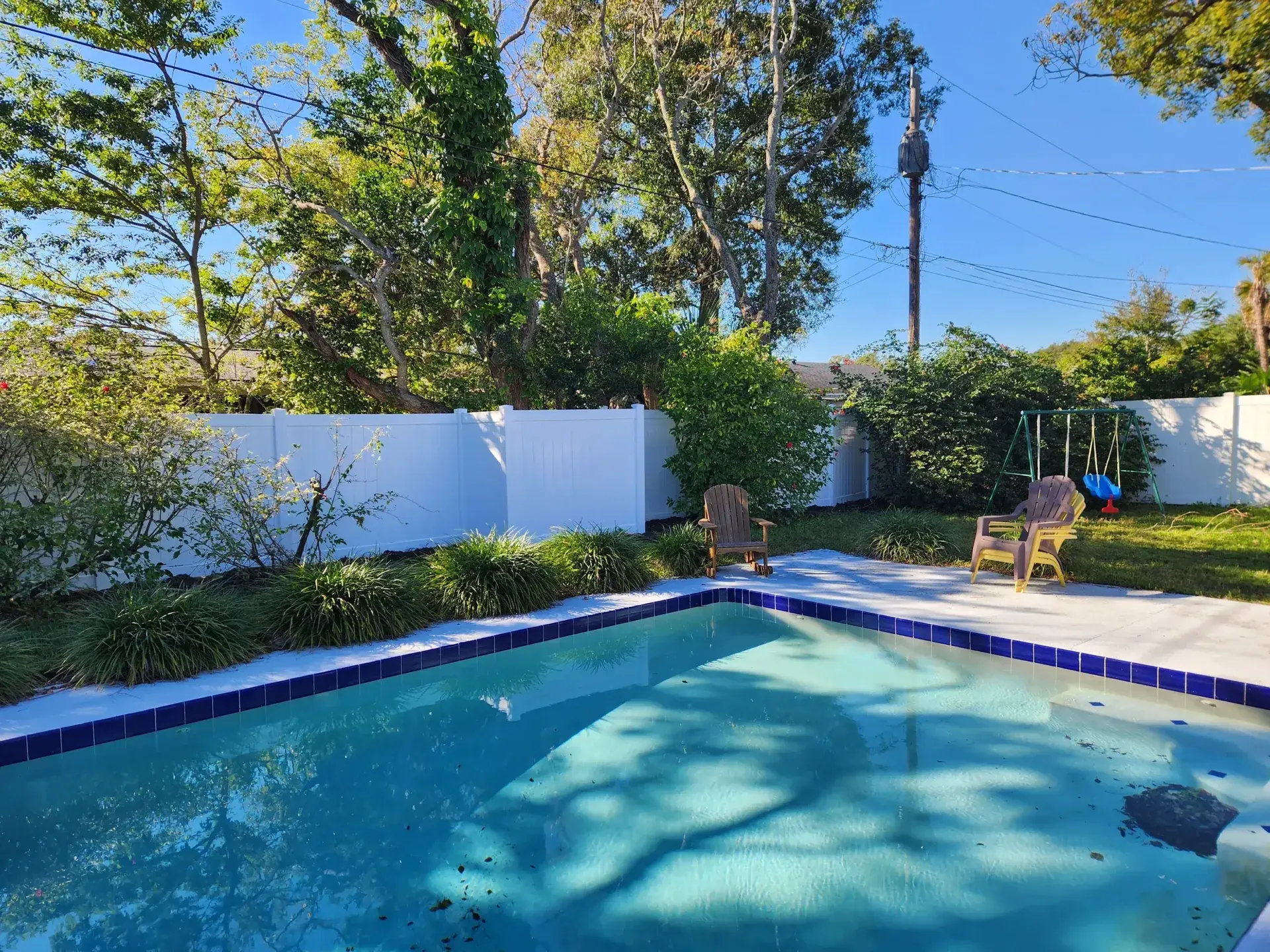
- Vinyl: a solid vinyl privacy fence makes a good barrier when you want privacy around the pool too. The smooth side faces out and rails face the pool. See our vinyl fences.
- Wood: works if it’s solid or tightly spaced, with the rails on the pool side. It needs more upkeep near pool water and sprinklers.
- Chain link: passes with standard 2-inch mesh and is the least expensive. It’s a common choice on large or lakefront lots, less so right around the deck.
What a code-compliant pool fence costs
These are installed prices from All County estimates written July to November 2026. Prices per foot depend on the length of the job, so the table shows the tier each price comes from:
| Item | Our installed price |
|---|---|
| 4 ft black aluminum, 2-rail pool style (the panel we use most on pool jobs) | About $30 per foot (150 to 250 ft); about $31 (100 to 150 ft) |
| 5 ft black aluminum, 3-rail (for a taller pool fence) | About $33 per foot (150 to 250 ft) |
| 4 ft aluminum pool walk gate, up to 5 ft wide | About $554 each |
| Pool latch, added to a gate | About $110 each |
| Permit, when we pull it | About $110 (Orange County, Ocoee) to $220 (Orlando and several other cities) |
Example: 120 feet of 4-foot aluminum pool fence with one walk gate and a pool latch, inside Orlando, comes to about $4,560 installed with the permit, before any specials. Short runs cost more per foot: the same fence on a 50- to 100-foot job ran about $38 per foot. Vinyl and wood pool fences follow our regular prices; the Orlando fence cost guide has every material.
Pool fence checklist before you sign
- Is the fence at least 48 inches tall on the outside along the whole run, including low spots?
- Will any opening, including under the fence and beside each gate, pass a 4-inch ball?
- Are rails closer than 45 inches apart on the pool side?
- Does every gate in the barrier open outward, self-close and self-latch, with the release at 54 inches or protected on the pool side?
- Do house doors and windows that open to the pool have alarms or self-closing hardware?
- Is anything climbable (AC unit, pump, planter, wall) next to the outside of the fence?
- Is a metal fence within 5 feet of the water, and if so, who handles bonding?
- Does the quote include the permit, and does your HOA need to approve the style first?
We plan pool fences around these questions on site, then build, test every gate and walk the finished barrier with you. Start with our pool fence installation page or book a free estimate.